I started thinking about this properly after a reader wrote to me about his pensions — a retired man, careful, organised, who wanted to make sure his wife would be alright if he went first. She wasn't confident with money, and his worry wasn't really the numbers. It was simpler than that: would she even know where to look?
That's what "getting your affairs in order" actually means. Not a morbid ritual — just making sure the map exists, and the important papers survive a house fire or a burst pipe. This guide is the checklist, then the honest practical bit: where to keep it all so it's safe and reachable.
The documents your family will actually need
You don't need everything — you need the things that unlock everything else. If someone had to act on your behalf, this is the short list that does the heavy lifting:
The core set
- Your willThe name and contact for your executor, too. A will nobody can find is almost as much trouble as no will at all.
- Lasting Power of AttorneyFor finances and for health. The one most people skip, and arguably the most important: it's what lets someone act for you if you're alive but can't manage things yourself.
- A one-page list of your accountsBanks, pensions, ISAs, investments, premium bonds — the providers and rough values, not the passwords. Enough that nothing gets lost or forgotten.
- PensionsEach scheme, and crucially your expression of wishes (nomination) form, which tells the scheme who should receive it.
- Life insuranceInsurer, policy number, and whether it's written in trust.
- PropertyThe deeds or the Land Registry title number, and the mortgage lender.
- Funeral wishesEven a few lines. It spares people from guessing.
- The essentials of identityBirth and marriage certificates, passport, National Insurance number.
Notice what's not on there: passwords. Don't write your banking passwords on a sheet in a drawer. A reputable password manager with a nominated "emergency access" contact, or a sealed note left with your solicitor, is the safer route. The list above is a signpost — it points to where things are, without becoming the thing a burglar dreams of finding.
Power of Attorney: the bit everyone leaves too late
A will handles what happens after you die. A Lasting Power of Attorney (LPA) handles the harder in-between — if a stroke, dementia or an accident means you're still here but can't manage your own money or decisions. Without one, your family can't simply step in; they'd have to apply to the Court of Protection, which is slow, costly and stressful at exactly the wrong moment.
There are two types — one for property and financial affairs, one for health and welfare — and you register them with the Office of the Public Guardian (gov.uk/power-of-attorney). You can do it yourself, or through a solicitor. Either way, it belongs on the list above, and in the safe below. If you read one line of this guide and act on it, make it this one.
Where to keep it all — safe and reachable
Two risks quietly threaten a lifetime of careful paperwork, and they're both cheap to solve:
- Destruction — a house fire or a flood taking out irreplaceable originals. UK home fires and burst pipes are far more common than people plan for.
- Nobody can find it — the documents exist, but they're scattered, and the one person who needs them doesn't know where to look.
The practical answer for most people is a fireproof document safe (or a fire- and water-resistant document bag) kept at home, with the original will lodged with your solicitor or the Probate Service if you prefer, and — the part that actually matters — one person you trust knowing it exists and where the key is. A bank safe-deposit box sounds secure but works against you here: they can be slow to open after a death, and banks have been closing them.
What to look for (before the brand)
- A stated fire time — 30 minutes is typical for home paper safes; longer is better. Check it's rated for paper, not just digital media (paper chars at a lower temperature).
- Water resistance — because the fire brigade, or a burst pipe, brings water. A combined fire-and-water rating is ideal; if your safe is fire-only, keeping the papers in a waterproof pouch inside it does the same job.
- Size — big enough to hold A4 without folding, plus a little room. Most people underestimate this.
- Security — a key or combination is fine for documents; if you'll store valuables too, look for one you can bolt down.
 Renters · a few papers
Fireproof & water-resistant document bag
If you rent, or you've only got the core set, this is where I'd start — about £16 for a silicone-coated pouch that's fire- and water-resistant. It won't deter a burglar, but it's the one item here that shrugs off a flood too, and it hides in any drawer.
Around £16
Check price on Amazon → Portable fireproof box
SentrySafe 1210 fireproof chest
A proper step up from a pouch: a compact, key-locking fireproof box for your documents and a bit of jewellery. Light enough to grab on the way out the door, and a long-proven little safe I'd happily trust with the essentials.
Around £40
Check price on Amazon → Best for most homes
SentrySafe 1170 fireproof safe
The one most homes actually want — 0.61 cu ft, UL-rated to take 30 minutes of fire, and heavy enough to bolt to the floor. Slip the waterproof bag above inside it and you've quietly covered fire and water in one. It's Amazon UK's most-reviewed safe, and I get why.
Around £119
Check price on Amazon →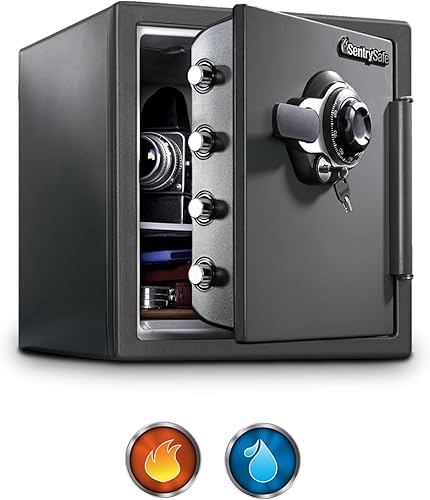 If it can't be replaced
SentrySafe SFW123 fire & water safe
Honestly? This is the one I'd buy for my own parents. A full hour of fire protection at 900°C+ — double everything else here — sealed against water for 24 hours, 39kg of steel, and a bolt-down kit in the box. Yes, £374 stings. But it's the difference between hoping the paperwork survives and knowing it will. If you've a drawer of things that genuinely can't be replaced, this is where they live.
Around £374
Check price on Amazon →One more, cheap and worth it: a shredder
Getting your affairs in order also means getting rid of what you don't need. Old bank statements, expired cards and anything with your name, address and account details are a gift to identity thieves — and identity fraud is a genuine financial risk, not a hypothetical one. A cross-cut shredder turns a shoebox of risk into recycling.
 Protect your data
Bonsaii 12-sheet cross-cut shredder
A P-4 cross-cut is the security level worth having for anything with personal details — well above the strip-cut basics. Bonsaii is a reliable home brand, and this one handles a proper household backlog.
Around £60
Check price on Amazon →The five-minute version
If a full sort-out feels like too much today, do just this:
- Write the one-page list of your accounts, pensions and where your will is.
- Tell one person you trust where that page lives.
- Sort a Lasting Power of Attorney — the single highest-value item on the list.
Everything else can follow. The difference between "sort of organised" and "genuinely sorted" is smaller than it looks, and it's felt most by the people who'll never have to say thank you for it.
Know exactly what you'd be leaving behind
WealthR keeps your accounts, pensions, property and net worth in one place — so the "list" is always current, and its Scenarios even model what your partner would be left with if you died first. Free forever, no bank linking.
Start tracking free →Related reading
- The real cost of long-term care in the UK — where Power of Attorney and a will matter most.
- Gifting money to your children & the 7-year rule — the estate-planning companion to this.
- Pension inheritance tax from April 2027 — what changes for what you leave behind.